Hose Hydrostatic Testing per ISO 1402 and ISO 7751
Hydrostatic testing is the most important quality-control check for verifying the structural integrity of a hose and its couplings before delivery or installation. This guide covers the reference standard, the test pressure ratio, why hose length matters, and the general conditions for a correct test.
What is hydrostatic testing?
Hydrostatic testing (proof pressure testing) is a method in which a hose or hose assembly is filled with water and pressurized above its rated working pressure — typically at a specified ratio to the working pressure — and held for a defined time to confirm there is no leakage, unacceptable deformation, burst, or damage to the reinforcement or couplings. It is a standard part of hose manufacturing quality control, and also of periodic in-service hose inspection, particularly for critical applications such as well control and BOP systems.
Reference standard: ISO 1402
The standard procedure for hydrostatic testing of rubber and plastic hoses and hose assemblies is defined in the international standard ISO 1402 — "Rubber and plastics hoses and hose assemblies — Hydrostatic testing". This standard specifies the pressurization method, the pressure ramp rate, the hold time at test pressure, how length change under pressure is measured, and the pass/fail criteria. Product standards such as SAE 100R, EN 856/857 and API 16C reference ISO 1402 (or its national equivalents) for each hose grade and define the test-pressure-to-working-pressure ratio for that grade — typically 1.5 to 2 times the working pressure, depending on grade and application.
Companion standard: ISO 7751 (proof pressure ratio)
Alongside ISO 1402, which defines the test procedure itself, the standard ISO 7751 — "Rubber and plastics hoses and hose assemblies — Ratios of proof and burst pressure to maximum working pressure" defines, for each hose, what multiple of its maximum working pressure the proof (test) pressure and the minimum allowable burst pressure should be. In short, ISO 1402 describes "how" the test is carried out, while ISO 7751 supplies the "ratio" — the test pressure figure — to be applied within that procedure; the two standards are normally used together and referenced side by side on hose test certificates.
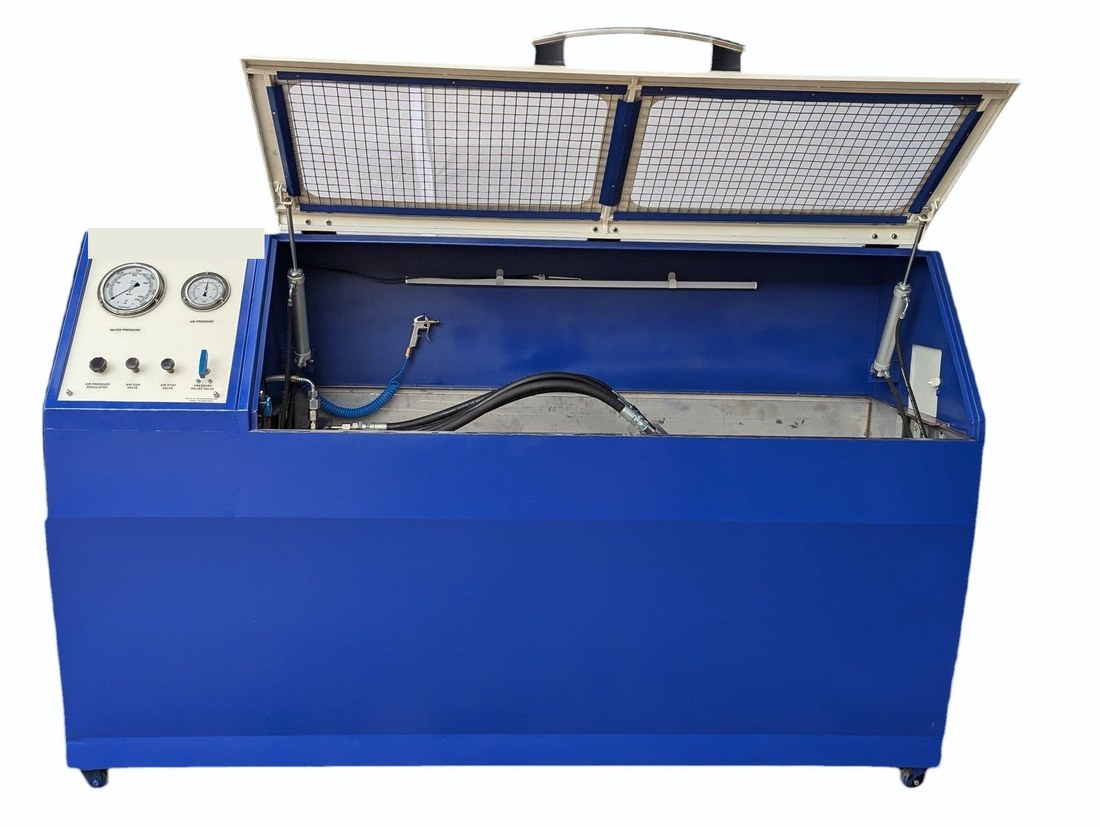
Example of a hydrostatic and pneumatic hose test bench with water/air pressure gauges and pressure control valves (illustrative image).
Why hose length matters in hydrostatic testing
The length of the tested hose or assembly directly affects the accuracy and validity of the test result:
- Measuring length change under pressure: wire- or fiber-reinforced hoses undergo a small length change when pressurized (typically in the range of roughly -4% to +2% of original length, depending on construction). This length change is one of the key control parameters in ISO 1402, and measuring it accurately requires a sufficient sample length; an overly short sample increases measurement error and may not correctly reveal the actual length change.
- Detecting cumulative reinforcement defects: inconsistencies in wire-braid lead angle, spacing between reinforcement strands, or localized defects in the reinforcement layers may only become apparent over a longer hose length rather than in a short test cut; testing the full assembly length gives greater confidence in the integrity of the structure along its entire run.
- Simulating actual installation conditions: for finished hose assemblies, the test should be performed on the actual length used in the project, since hose behavior under pressure — particularly along a routed, bent path — depends on the real length and geometry of the installation.
General hose condition during testing
- Complete removal of trapped air: before applying test pressure, the hose must be fully purged of air and filled with water; trapped air in a hydrostatic test system is dangerous because of its compressibility — if the hose fails, energy stored in compressed air can release suddenly and violently.
- Straight, unrestrained layout (no bending): per the ISO 1402 procedure — particularly whenever length change under pressure is being measured — the hose must be laid out fully straight, horizontally, on a flat and smooth surface (or supported on rollers, or suspended vertically) so it can expand and contract freely under pressure with no restriction. Bending the hose during the test restricts this natural expansion and can distort both the length-change measurement and the detection of leaks or deformation. This is a separate requirement from the hose's minimum permissible bend radius (R min) for in-service installation, which applies to operating conditions, not to hydrostatic test geometry.
- Correct couplings and standard crimping: couplings at both ends must be assembled per the manufacturer's technical instructions using calibrated crimping equipment; an improperly assembled coupling can separate under test pressure and produce a false failure.
- Gradual pressure ramp: pressure must be increased gradually and under control — not in a sudden surge — up to the test pressure, to avoid shocking the hose structure and couplings.
- Hold time: the test pressure must be held for the duration specified by the applicable hose grade standard (typically 30 seconds to 2 minutes) without a noticeable pressure drop.
- Ambient and water temperature: the temperature of the test water and environment should be recorded and kept within the standard's permitted range; unusual temperatures can affect the hose's mechanical behavior.
- Visual inspection under pressure: during the hold period, the hose and couplings should be visually inspected for weeping, air bubbles, localized deformation, or coupling movement.
Acceptance criteria
A hose or hose assembly passes the hydrostatic test if, throughout the hold period at test pressure, there is no leakage from the body or couplings, no noticeable pressure drop, no permanent deformation, no delamination, and no burst. The result is typically recorded on a test certificate together with the serial number, test pressure, duration and date, so it remains traceable.
Important note: does the test affect the tested hose's service life?
Per ISO 7751, the test pressure ratio (typically 1.5 to 2 times working pressure) is deliberately chosen well below the hose's burst pressure; this is why a correctly executed standard hydrostatic test (controlled ramp rate, hold time per the standard) on a sound hose is normally considered non-destructive — it is exactly what makes 100% production-line testing possible without disqualifying the hose from service afterward. That said, from an engineering standpoint, every pressurize/depressurize cycle — even within the qualified range — theoretically consumes a small amount of the hose's fatigue life. In practice, this means: keep the hold time limited to what the standard requires for inspection (no longer than necessary), avoid unnecessary repeat testing of the same sample, and perform periodic in-service retests (for example on well-control hoses) only at the intervals set by the standard or manufacturer, not arbitrarily or excessively often.
Need a hydrostatic test certificate for your hose assembly?
Send us the hose grade, assembly length and system working pressure, and we will calculate the test pressure per standard and issue a test certificate.