
Hose Bend Radius and Correct Installation Practice
Respecting the minimum bend radius and correct assembly geometry is the single most direct way to prevent premature failure, abrasion and reduced service life in hydraulic and industrial hose.
Why bend radius matters
One of the most common causes of premature failure in hydraulic and industrial hose is not excessive working pressure, but incorrect installation geometry and over-bending. Every hose has a minimum permissible bend radius (R min), determined by its reinforcement structure (wire or textile layers). Bending it tighter than this value places the reinforcement layers under mechanical stress they are not designed for, weakens the hose structure prematurely, and can noticeably shorten service life or even cause early rupture. Respecting bend radius in route design and installation costs far less than early hose replacement or unplanned downtime.
Principles of correct hose assembly geometry
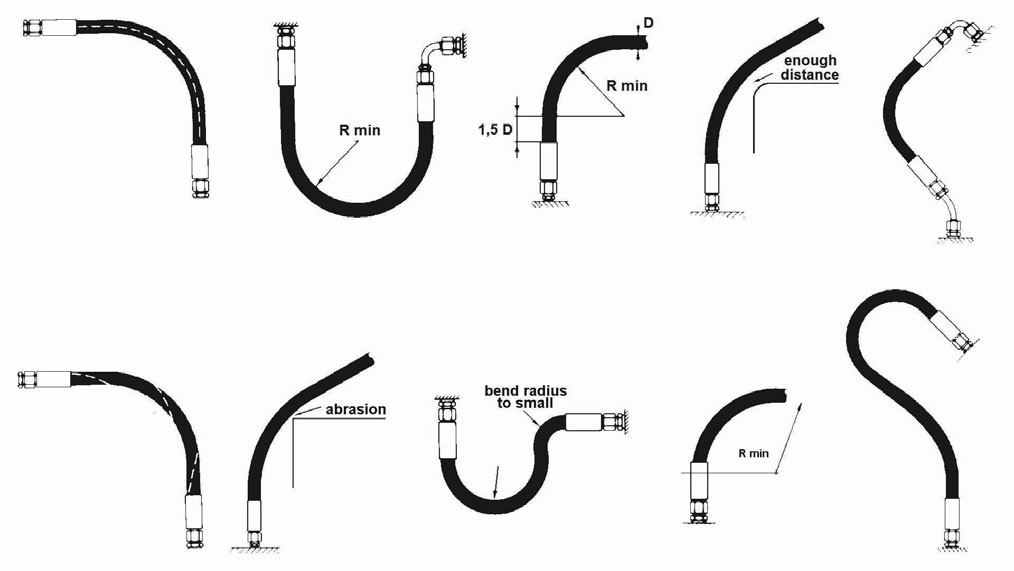
- Respect the minimum bend radius (R min): The hose route must be designed so the bend radius never falls below the minimum stated in the catalogue for that hose grade, at any point.
- Enough distance from the fitting: Near each hose end, a straight section of hose (typically at least 1.5 times the hose diameter, or 1.5D) should be left before any bend begins; bending immediately at the connection places excessive mechanical stress on the ferrule and fitting.
- Bending in a single plane only: The assembly route should ensure the hose bends in one plane only; torsion and axial traction occurring together with bending should be eliminated.
- Length change under pressure: Hose length can change by roughly −4% to +2% when pressurised; the assembly length must allow for this.
- Free-swivelling connections: Where torsion is present, use free-swivelling fittings so torsion is not transmitted into the hose body.
Common installation errors and their consequences
The image below, from a technical guide on hydraulic hose selection and installation, shows correct examples (top row) and incorrect examples (bottom row) of assembly geometry:
| Installation error | Technical consequence |
|---|---|
| Bending immediately at the fitting (no 1.5D clearance) | Concentrated mechanical stress on the ferrule and fitting, risk of joint separation |
| Bend radius smaller than R min | Damage to the wire reinforcement layers, sharply reduced service life |
| Hose contact with fixed or moving surfaces (abrasion) | Wear of the outer cover, exposed wire reinforcement and premature leakage |
| S-shaped bend or bending in more than one plane | Unintended torsion, uneven stress on the reinforcement layers |
Other factors affecting hose selection and installation
- Working pressure: The hose's working pressure must exceed the system's maximum operating pressure, allowing for momentary pressure peaks.
- Temperature: The fluid temperature (both flowing and with the equipment stopped) and the ambient temperature around the hose route must not exceed the maximum working temperature of the selected grade.
- Fluid compatibility: The chemical compatibility of the hose tube and fitting material with the conveyed fluid should be checked before final selection; incompatible fluids can contaminate the system and cause premature damage.
- Correct coupling: Use the coupling series recommended for each hose grade and follow the crimping/assembly instructions; an unsuitable coupling can damage the hose and lead to premature failure.
Need technical advice on the right hose grade and installation route?
Send us the working pressure, size and assembly route of your line and we will advise on the correct grade from the technical catalogue.